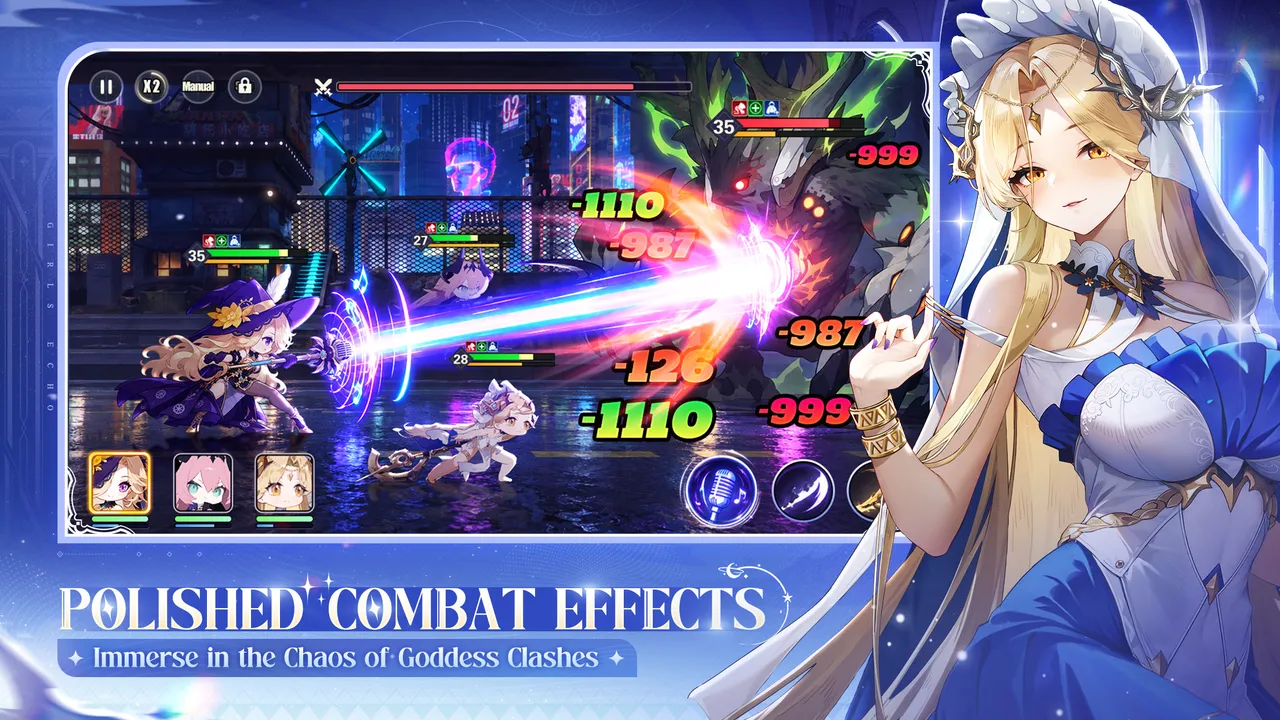
Start with jobs, not a five-name template
A useful Girls Echo team begins with three questions: who absorbs pressure, who keeps the group functioning, and who finishes the fight? The official store description confirms that the game centers on building and developing a goddess team. Public guide material adds a more specific framework: five characters deploy together, so each slot should contribute to durability, recovery, damage, or a synergy that improves those jobs.
That is more dependable than copying a ranked list without looking at your account. A highly ranked character with no useful partners or star development may solve less than a lower-ranked character you can actually upgrade. Treat rankings as a shortlist for inspection. Your roster, duplicate count, current stage, and current version decide whether a suggestion works.
Fill the frontline first
If your team collapses before its damage plan develops, start by inspecting the frontline. The public character guide describes Amaterasu as a tank whose kit is associated with HP-based damage, self-healing, damage reduction, and temporary protection. Mobi.gg also places Amaterasu among its strongest November 2026 picks and describes her as a durable tank. That agreement makes her a sensible character to inspect when available, but it does not make her mandatory.
Look for the same functions in the characters you own: damage reduction, self-healing, shielding, control, or abilities that scale from durability. Put fragile attackers and healers away from the most exposed positions when the formation screen allows it. If the front still falls immediately, raising another damage dealer is unlikely to fix the immediate problem.
Separate healing from damage
A balanced team normally needs a recovery plan. Both reviewed guides highlight Medusa as a healer and support. Their descriptions associate her with healing injured allies and improving allied attack, while Mobi.gg additionally reports an emergency revive effect. Because those details come from third-party guides, confirm the live skill wording in your client before planning around a specific percentage or trigger.
Other healers may fit better when they are more developed or align with a faction plan. The useful comparison is not simply “which healer ranks highest?” Compare healing target, frequency, extra buffs, survivability, and whether the character can be upgraded now. A support who keeps the team alive and improves the main attacker can contribute more than a second damage dealer who never reaches a decisive skill.
Pick one clear damage direction
After the team can survive, choose how it will win. Area damage helps when several enemies must be cleared. Focused damage matters more when a single target controls the encounter. Public guides also describe status-based directions, especially burn and poison. Izanami and Phoenix are repeatedly associated with burn teams; Kaguya, Azure or Azur, and Hera appear in poison-oriented suggestions. Spellings differ between sources, so use the name shown in your own client.
Do not add a status character just because a guide labels the archetype strong. Read whether one character applies the effect and whether another actually benefits from it. A coherent pair—an effect applier plus a character whose skill rewards attacking affected enemies—has a clearer purpose than five unrelated high-rarity units. Preserve a tank and recovery slot while testing the remaining damage positions.
Check elements and formation bonuses
The reviewed character guide reports a four-element counter loop: Water over Fire, Fire over Wind, Wind over Earth, and Earth over Water. It also reports faction or formation bonuses, including an attack and HP bonus for a full same-faction group. These are useful checks when a team that looks strong on paper performs poorly.
Elemental advantage and formation bonuses should not be used in isolation. Replacing your only healer to complete a faction group can reduce real survival even if the formation number rises. Compare the whole result: does the team live longer, keep its damage dealer active, and finish the stage? Change one slot at a time so the next battle gives you interpretable feedback.
Use a five-slot planning worksheet
For a first pass, assign each slot a job before assigning a name:
- Frontline: a tank or durable character who can receive pressure.
- Recovery: a healer, shielder, or support with reliable protection.
- Main damage: the best-developed attacker for the current encounter.
- Synergy: an effect applier, buffer, debuffer, or faction partner who improves the main plan.
- Flexible slot: more area damage, boss damage, control, or extra survival based on what is failing.
This worksheet is deliberately role-based. It remains useful when banners change or when two accounts have completely different pulls. If your team survives but times out, use the flexible slot for more damage or a damage amplifier. If it dies early, add protection or recovery. If one enemy is the problem, trade broad area damage for a focused attacker.
Invest in the team you can develop
Third-party guides describe levels, star upgrades from duplicates, equipment, and bonds as connected growth systems. They also describe a resonance system that shares a level based on five developed characters. The practical lesson is to avoid spreading scarce resources across every new pull. Keep the core five progressing together, then use shared systems to experiment with alternatives where the game permits it.
Before consuming a selector or limited upgrade item, read the reward rules and the next star upgrade. Confirm whether the item is random or selectable, which characters are eligible, and what the next upgrade changes. A duplicate for an active, well-supported unit may produce an immediate improvement; a new character may offer flexibility but require substantially more investment.
When should you replace a character?
Replace a character when you can explain the problem and the new unit’s job. “This unit ranks higher” is not enough. Better reasons include: the frontline cannot survive, healing arrives too late, the team lacks focused damage for a boss, or a new partner completes a documented burn or poison interaction.
After the change, compare the same type of encounter. Watch whether the failure point moved. If the team now survives but lacks damage, the defensive change worked and revealed the next constraint. If performance worsens, restore the prior slot and test a different variable. This measured approach is slower than copying a tier list, but it creates advice that belongs to your actual roster.
Characters worth inspecting first
Across the two reviewed guides, several names recur in useful roles: Amaterasu for frontline durability, Medusa for healing and support, Thor for focused critical damage, Izanami for burn-oriented damage, and Michael for damage plus debuffs. Mobi.gg also highlights Aether, Pilgrim, Thanatos, Diaochan, and others in its highest group. These are source-reported recommendations, not this site’s independent ranking.
Use the overlap to decide which skill pages to read first, not which account to discard. A developed Phoenix with the right burn partners may serve your account better than an undeveloped name from the top of a general list. A healer that matches your available duplicates may be the correct choice even when another guide ranks a different healer higher.
Team-building questions
Do I need a perfect tier-list team?
No. Tier lists simplify broad comparisons. A functioning frontline, recovery plan, damage plan, and available upgrades matter more than collecting five names from one ranking.
Should every character share an element or faction?
Not automatically. Formation bonuses can help, but losing an essential role can make the overall team worse. Compare the complete formation and the actual encounter result.
Is rerolling required?
No. The reviewed guides treat rerolling as optional. Continuing with a balanced, developable roster can be more useful than repeatedly restarting for one name.
Has this team advice been tested in game?
No. This site did not install or play Girls Echo. The page is an editorial synthesis of official positioning and the two public guides linked below, with uncertainty stated where claims are version-dependent.
Sources and review limits
- Girls Echo on Google Play — official game positioning and developer identity.
- Girls Echo Wiki character guide — roles, five-character formation, elements, synergies, and growth-system descriptions; reviewed November 6, 2026.
- Mobi.gg November 2026 tier list — a separate current ranking and role descriptions used only for cross-checking recurring recommendations.
Neither third-party source is an official balance document. This page does not reproduce either ranking, claim access to game data, or promise a best team for every mode. Confirm names, skills, rates, and bonuses in the current client.